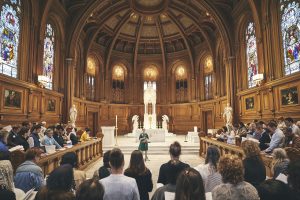
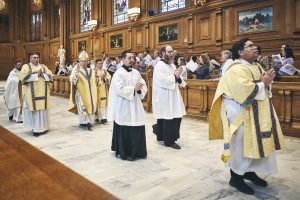
The Catholic Institute of Sacred Music was happy to collaborate with the Benedict XVI Institute in an evening of prayer and learning about the situation of Christians persecuted for their faith in China and Hong Kong.
The evening began with Exposition and Benediction of the Blessed Sacrament, led by Archbishop Cordileone. Special music for the Holy Hour included the premiere of a new composition by Dr. Frank La Rocca (a CISM faculty member) on a text by James Matthew Wilson, “Stanzas for the Chinese Martyrs,” commissioned by the Benedict XVI Institute for Sacred Music and Divine Worship. Other compositions by Diana Corliss, Kevin Allen, and Paul Jernberg will also be sung by the choir, directed by CISM Director, Dr. Jennifer Donelson-Nowicka. Read more about the event and Dr. La Rocca’s piece at this article in National Catholic Register.
The Holy Hour was followed by the second and final event of the 2023–2024 St. Patrick’s Seminary Lecture Series. The lecture by William McGurn, opinion columnist for The Wall Street Journal and godfather of Jimmy Lai, is entitled “The Prison Witness of Jimmy Lai.” Jimmy Lai is the founder of the popular Hong Kong paper Apple Daily, who has now been imprisoned in solitary confinement for organizing pro-democracy protests.
The last event of our 2023–2024 Public Lecture and Concert Series was a wonderful lecture by Fr. Cassian Folsom, O.S.B., a foremost historian of books of the Roman rite, and is a preview of some content in his forthcoming book about books of the Roman rite that he is writing while on sabbatical from San Anselmo in Rome.
As he writes:
The history of the Graduale Romanum is long, complex and full of surprises. Knowing some of that history is a great help in understanding the status of liturgical music today. This conference will be limited to a history of chant books used for the Mass. (Chant books used for the Divine Office is another story for another time.) The period of time we’re dealing with extends from the Council of Trent to the post-Vatican II era. We will briefly describe six books: 1) the Medicea edition of the Graduale Romanum (1614–1615), 2) the Solesmes movement and the Liber Usualis (1896), 3) the Graduale Romanum commissioned by Pope Pius X (1908), 4) the Vatican II document on the sacred liturgy and the Graduale Simplex (1967), 5) the Graduale Romanum of 1974/1979 and the Graduale Triplex (1979) and finally, 6) the Graduale Novum (2011/2018).
Because there is so much material, an in-depth study is not possible in this conference. Rather, we will focus on the highlights, and try to trace the ever-present tensions between tradition and reform.
Archbishop Cordileone’s Talk at our first Sacred Music Study Day on April 20, 2024 was splendid – a great overview of the basics of sacred music from the Church’s perspective.
Unfortunately we didn’t capture a file with great sound quality of the talk, which was given in a large lecture hall, in front of a large audience. Nevertheless we’re posting the audio of it so that you don’t miss out on the important and helpful things he said.
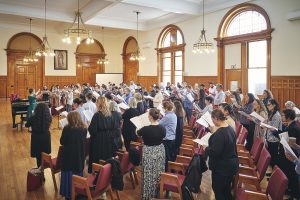
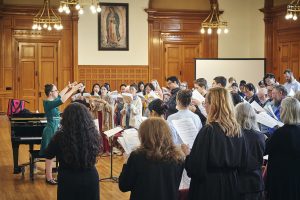
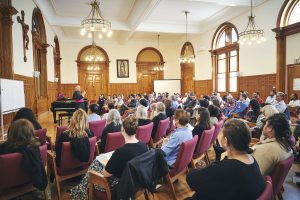
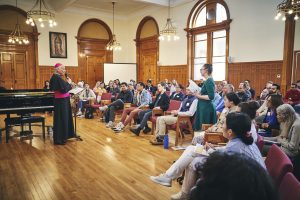
We held our first annual Sacred Music Study Day yesterday, April 20th. 110 singers from the area joined us, along with a few visitors from Sacramento, Stockton, L.A., and Mexico. Archbishop Cordileone gave a talk on some fundamental principles of sacred music and celebrated the closing Marian votive Mass for us. Stay tuned for audio of his talk, and in the meantime enjoy some photos of the day. Photography by Karolina Zapolska.
The Catholic Institute of Sacred Music at St. Patrick’s Seminary in Menlo Park, California is proud to announce its second summer term. Through the sponsorship of generous donors, we are delighted to be able to offer all courses with FREE TUITION for all applicants who are accepted into the program for this summer.
The Catholic Institute of Sacred Music offers a rich learning experience for parish and school musicians who want to immerse themselves in the beauty, truth, and holiness of the Church’s sacred music and liturgy. The Institute offers a daily schedule of sung liturgies on campus and opportunities for private prayer, a world-class faculty, dormitory rooms and common meals on a beautiful campus in the temperate climate of Silicon Valley, and opportunities for study, both in-person and online, in subjects that are inspiring, challenging, and practical.
Whether you’re new to sacred music or have studied music at the graduate level, our courses will assist you in unlocking the treasury of Catholic sacred music, helping you grow in your spiritual life, amplifying your knowledge of and love for Christ and the Church’s music, and strengthening the skills needed for faithful service in the Church.
Join us this summer to experience the depths of the Church’s riches, taught by experienced teachers and musicians, faithful to the Church’s magisterium and tradition.

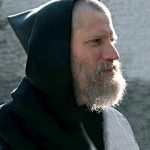 The last event of our 2023–2024 Public Lecture and Concert Series was a wonderful lecture by Fr. Cassian Folsom, O.S.B., a foremost historian of books of the Roman rite, and is a preview of some content in his forthcoming book about books of the Roman rite that he is writing while on sabbatical from San Anselmo in Rome.
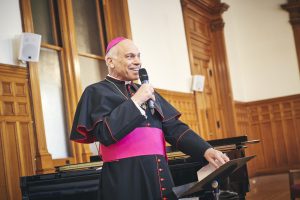 Archbishop Cordileone’s Talk at our first Sacred Music Study Day on April 20, 2024 was splendid – a great overview of the basics of sacred music from the Church’s perspective.